
Shockwave therapy in Sandbach
A non-invasive treatment for long-standing tendon and soft tissue pain, delivered by chartered physiotherapists. Initial assessment from just £40.
Hundreds of patients treated
Trusted across Cheshire for hands-on, evidence-based recovery.
HCPC-registered physios
Regulated, accountable, evidence-based care at every appointment.
5.0 rated · Best Wellbeing Business
Cheshire Wellbeing Business of the Year 2026, rated 5.0 by our patients.
What is shockwave therapy?
Shockwave therapy, or extracorporeal shockwave therapy (ESWT), is a non-invasive treatment that uses controlled, high-energy sound waves to stimulate healing in tendons and soft tissue.
Delivered through a handheld device applied to the skin, it needs no injections, anaesthetic or downtime, and is most often used for long-standing problems where normal healing has slowed or stalled.
Radial
pressure wavesHow shockwave works
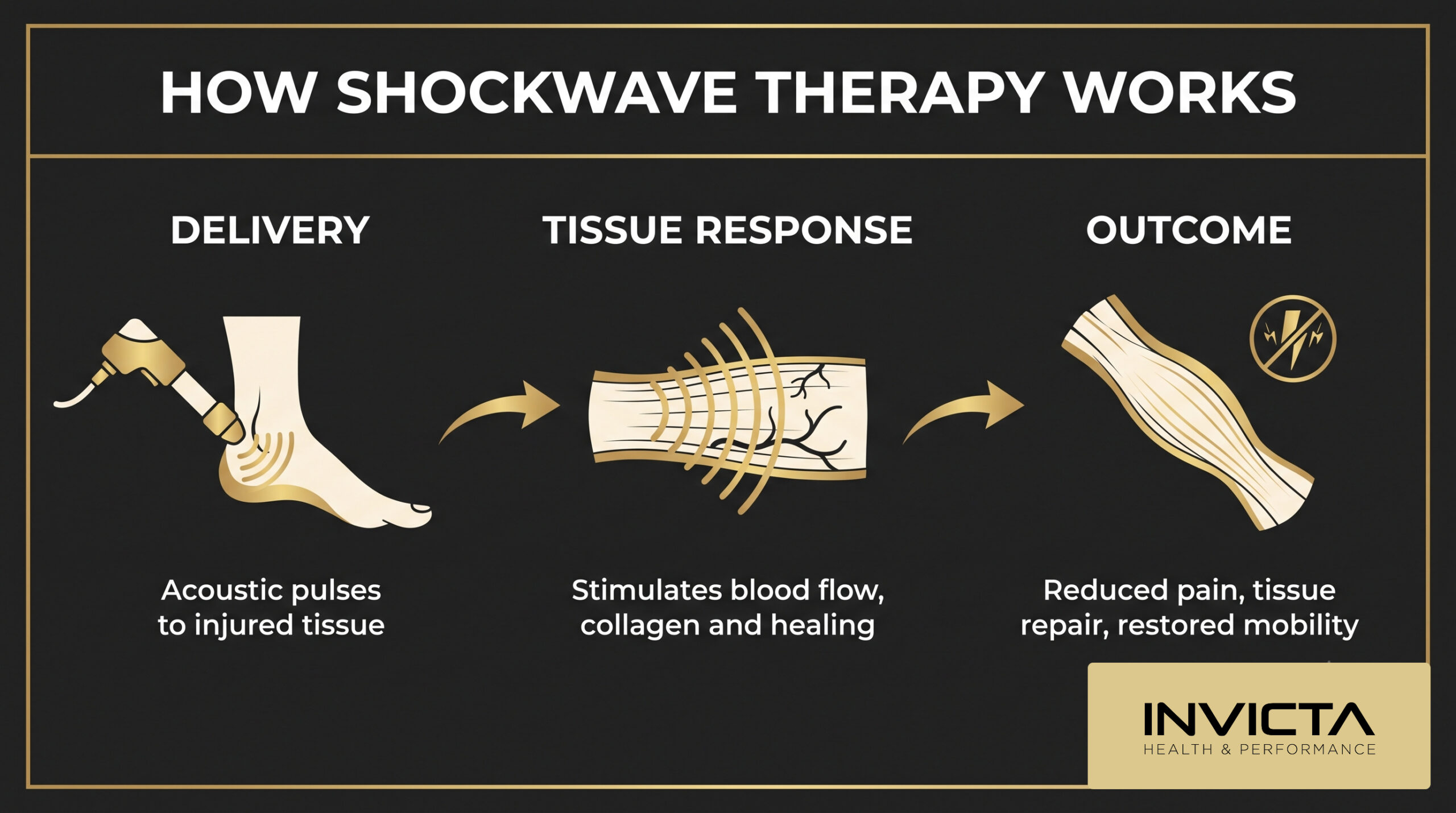
The acoustic waves create a mechanical stimulus that increases local blood flow, stimulates the cells responsible for tendon repair, and interrupts chronic pain signals. Together these restart the healing response in tissue that has become “stuck”, which is why shockwave helps with persistent injuries that haven’t responded to rest or exercise alone.
Why radial?
Radial shockwave suits the majority of tendon and soft tissue conditions we treat, helping with generalised pain and circulation across larger areas. This is the type we use here at Invicta.
What to expect from shockwave therapy
From your first assessment to full recovery, here’s how a course of shockwave therapy works.
Step 1
Your Assessment
Every course starts with a full assessment to confirm shockwave is right for you. We check your symptoms, how long they’ve been present, and rule out anything that makes treatment unsuitable.
Step 2
Your Treatment Course
Most people need a short course of 5–8 sessions, delivered in 30-minute appointments. Each session combines shockwave with hands-on treatment or rehab, and intensity is adjusted to stay comfortable.
Step 3
Your Recovery
Shockwave works by stimulating natural healing, so improvement is gradual rather than instant. Some notice changes within a couple of weeks, with many improving further over the weeks after treatment ends.
Conditions shockwave therapy treats
Shockwave (ESWT) works best for long-standing tendon and soft tissue conditions where delayed healing is driving ongoing pain. Below are the ones we treat most often at our Sandbach and Holmes Chapel clinics; if your condition isn’t listed, it’s still worth asking.
Does shockwave help with plantar fasciitis?
Yes. ESWT is often used for chronic plantar fasciitis (also called plantar heel pain), and may be helpful when symptoms have lasted several months and haven’t improved with initial care such as activity changes, better footwear and rehab exercises.
In clinic, the best results usually come when shockwave is combined with a rehab plan focused on calf and foot strength, gradual loading, and correcting the training errors adding stress to the heel.
Does shockwave help with Achilles tendinopathy?
Shockwave therapy may help with Achilles tendinopathy, particularly when symptoms have lasted some time and haven’t fully improved with exercise-based rehab alone. Evidence suggests ESWT can reduce pain and improve function in some people, and it tends to work best alongside a clear tendon-loading plan rather than as a standalone treatment.
NICE has published guidance noting its use in longer-term cases while highlighting the importance of careful patient selection. At Invicta, we usually use it as part of a wider plan that may include progressive calf strengthening, load management and a return-to-run plan.
Does shockwave help with tennis elbow?
Shockwave therapy may help some people with tennis elbow (lateral epicondylitis), most often when symptoms have become long term. Some evidence shows improvements in pain and function compared with certain passive treatments, though results are more mixed against other options.
In our experience it works best paired with a structured rehab plan: wrist and forearm strengthening, load changes, and a gradual return to sport, gym or work.
Does shockwave help with golfer’s elbow?
Yes, it can help with golfer’s elbow (medial epicondylitis), particularly when symptoms are persistent. Like other tendinopathies, golfer’s elbow is characterised by failed healing and tissue disorganisation rather than inflammation.
Emerging clinical research suggests ESWT may reduce medial elbow pain, improve grip strength and function, and offer an alternative to repeated corticosteroid injections.
Does shockwave help with patellar tendinopathy?
Shockwave therapy may help with patellar tendinopathy (jumper’s knee), particularly in stubborn cases that haven’t fully responded to loading-based rehab. Evidence suggests ESWT can reduce pain and support a return to sport in some people, and it’s generally used to complement rather than replace a progressive strengthening programme.
At Invicta we typically pair it with a structured tendon-loading plan, activity modification, and a graded return to jumping or running.
Does shockwave help with greater trochanteric pain syndrome?
Shockwave therapy may help with greater trochanteric pain syndrome (pain on the outside of the hip, often linked to gluteal tendinopathy), especially when symptoms are long-standing. Some evidence suggests ESWT can reduce pain and improve function, and it tends to work best alongside targeted gluteal strengthening and load management rather than on its own.
We use it as part of a wider plan to settle symptoms and rebuild capacity around the hip, including a gradual return to walking, running or training.
Shockwave therapy questions
Common questions about shockwave therapy (ESWT). If something’s not covered here, get in touch and we’ll talk it through.
Shockwave therapy can feel uncomfortable, but it should always stay tolerable. You’ll feel a rapid tapping or pulsing over the treated area, and the intensity is adjusted throughout your session to keep it manageable while still effective. Many patients report their symptoms feel easier immediately afterwards.
Shockwave therapy is a safe, evidence-based treatment when delivered by trained clinicians after a proper assessment. Side effects are usually mild and short-lived, such as soreness or redness in the treated area, and at Invicta every course begins with a full assessment to confirm it’s right for you.
Shockwave therapy may not be suitable if you’re pregnant, have a bleeding disorder, have an active infection in the treatment area, or have certain other medical conditions. Suitability is always confirmed during your assessment before any treatment begins.
When delivered by a trained clinician after assessment, shockwave therapy is very unlikely to cause harm. The most common effects are temporary soreness or redness, and we screen for anyone unsuitable beforehand to keep treatment safe.
At Invicta, a standard 30-minute appointment is £65, with care packages reducing this to as low as £55 per session. Each appointment allows treatment of one to two areas alongside hands-on treatment or rehab. Call the team on 01270 748200 to discuss the right option for you.
Shockwave therapy is used within the NHS for some conditions, but access can be limited and waiting times may apply, so many people choose private treatment for faster care. Invicta offers it at our Sandbach and Holmes Chapel clinics in Cheshire.
It’s usually best to avoid heavy or high-intensity loading of the treated area for a day or two, while keeping up any prescribed rehab exercises. Your physiotherapist will give you specific guidance based on your condition.
Wear comfortable clothing that gives easy access to the treatment area. For lower-limb conditions, shorts or loose trousers work well; for shoulder or upper-limb conditions, a vest or loose-fitting top is ideal.
Problem Areas
See allGET IN TOUCH
WE WOULD LOVE TO HEAR FROM YOU
Complete our contact form or use the contact methods below and we will be in touch as soon as we can.